





How great leaders inspire action | Simon Sinek
“People don’t buy what you do; they buy why you do it.” Author & journalist Simon Sinek repeats this expression all throughout his TED Talk. Whether it’s about your presence in an event, casting a vote, or selecting a product or service, humans are wired to proceed in response to a fundamental idea or principle. Understanding this theory will help you grab attention, influence behaviour and reach more people.
What gives the great leaders their edge?
Why were Martin Luther King, Wright Brothers, & Steve Jobs successful when others have access to comparable resources and environment? The thing these influential people have in common is summarised in the ‘Golden Circle’.
- What – every administration should be familiar with this
- How – some know this – their differentiating values, or intellectual property
- Why – only the best know this – why their organisation exists beyond a profit
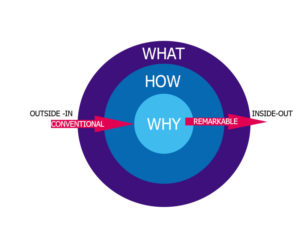
The best organisations can illustrate and sell the ‘why’ first, and use this to motivate others. People don’t buy what you do, but why you do it. Using Apple as an instance, their sales statements begin with their “why” – they design in a different way to push the limits. Once you agree to them why, you trust them to build anything for you – a computer, an MP3 player and phone. Other quality electronics companies are known for 1 product (For Example Dell computers) struggle to sell anything else because they are only known for what they make not why.
This is what people speak to when they answer ‘why’. Answering ‘what’ deals with fact, statistics, but still might not feel right on gut feeling.
Simon gives an instance of the Wright brothers against Samuel Pierpont Langley. Samuel had all the usually be the recipes to success on his side – money, market conditions, and a well-informed and associated team. But while Samuel was driven by affluence and authority, the Wright brother’s team were encouraged by the idea of changing the course of history with powered flight. The Wright brothers achieved flight first, and Samuel instantly quit once the goal of being first was out of reach.
Different people are comfortable to accept new technology at different times. The early adopters take up the first 15-18%, with the mainstream being the next 68%. The mainstream needs the early adopters to try it first, on gut instinct. This makes hitting 20% market share essential – hitting the tipping point where the mainstream will start to take up rapidly. Early adopters are sold everything on the ‘why’ – they will take on a poor quality product if they like the idea behind it.
The following TED talk, given by Simon Sinek, describes how it is that great leaders motivate action, why some people are able to attain things when others are not. He explains the brilliant, biologically based “Golden Circle”, a new way of looking at how people approach what they do. He also discusses the Law of Diffusion of Innovation. And weaves it all together with several intensely told instances. From Apple computer to the Wright Brothers, to Martin Luther King, Jr.
Watch the entire session here:
https://www.youtube.com/watch?v=qp0HIF3SfI4