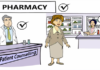







Community pharmacy is the place where compounding and dispensing of prescription is carried out under the direct supervision of registered pharmacist. Generally community pharmacy is called as medical stores. It was calculated that about half of million young people visit to the community pharmacy for medicines. Community pharmacies generally met on the high street, crowed area, busy area and in the centre of the most seize communities. Community pharmacies are of different sizes ranging from the larger multiples to the small individually owned pharmacies. Community pharmacist is the health professional most susceptible to the public. He is responsible for supply of medicines to the patient, counseling of the patient, drug information to the health care providers and participation in health care programs. They maintain relationship with other health professionals in primary health care.
Role of pharmacist in community pharmacy:
Operating the prescription
The pharmacist is responsible for verification of legality, safety and correctness of the prescription. The pharmacist checks the patient drug history before dispensing the prescription to the patient, ensures that correct amount of drug is dispensed to the patient. In many countries, it is the job of pharmacist to know about past and current drug record of the patient so that he can provide essential advice to the health care provider.
Clinical pharmacy
The pharmacist collects and integrates information about the patient’s drug history, dosage regimen and method of administration and gives the advice related to use of drug to the patient.
Drug monitoring
The pharmacist can participate in practice research projects and schemes to analyze prescriptions for the monitoring of adverse drug reactions.
Extemporaneous preparation of medicines
Pharmacists everywhere continue to prepare medicines in the pharmacy. This enables them to adapt the formulation of a medicine to the needs of an individual patient. in developed or developing countries most of the community pharmacists are involve in casual manufacturing of medicines according to GMP.
Traditional and alternative medicines
In some countries, pharmacists supply traditional medicines and dispense homoeopathic prescriptions.
Responding to symptoms of minor disease
The pharmacist also gives advice to the patients on various symptoms of disease. If the symptoms are minor then pharmacist can give medicine with advice of consulting a physician.
Information to the health care professionals and the public
The community pharmacist provides information on drugs and particularly on newly introduced drugs. He provides this information to other health care professionals as well as to the patients and uses it in enhancing the rational use of drugs by giving advice to the physicians and to the public.
Health promotion
The pharmacist can take part in health promotion programs on health-related topics as well as drug-related topics. They may also take part in the educational programs of local community groups in health promotion, and prevention of disease like Expanded Programme on Immunization.
Domiciliary services
In a number of countries, the pharmacist provides an advisory as well as a supply service to residential homes for the elderly, and other long-term patients. In some countries, policies are being developed under which pharmacists will visit certain categories of house-bound patients to provide the counselling service that the patients would have received had they been able to visit the pharmacy.
Agricultural and veterinary practice
Community Pharmacist is also responsible for supply of animal medicines and medicated animal feeds.